
For Chuck Todd, it's about driving the backseat
Chuck Todd, one of the greatest political journalists of our generation, joins me on Being young with Inyoung!

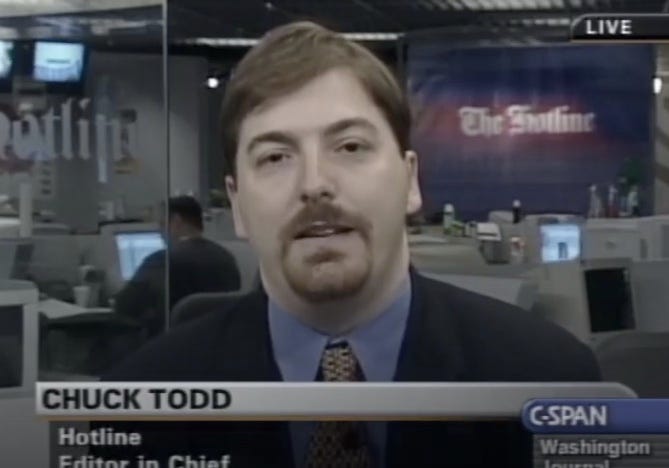
Chuck apparently doesn’t like taking photos of himself. So I screenshot this clip of him on C-SPAN when he was the EIC of Hotline. Thank you, C-SPAN, in advance.
Chuck Todd is, in a way, back where he started – except, whether he likes it or not, he’s now Chuck Todd™.
Chuck spends his time working on three large buckets of work spread across (a) content (podcast, Substack, video spanning political history and analysis, sports analysis and perhaps what the public knows him best for – interviews), (b) local news entrepreneurship and (c) political reform efforts addressing polarization through issues like the party primary system. These efforts all work in tandem where the sum of the parts are greater than the individual pieces themselves.
And in a way, he’s going back to his professional roots. He launched his professional career in media at The Hotline in the early 90s – where he basically worked with a team to create the OG version of digital/online political news (Chuck used the term “godfather,” I will stick with OG here). He has now essentially returned to that space but in between where he started and where he is now is time and a legendary career that has made him a household name for many.
“It’s easier to get a meeting,” he says, noting that his name recognition functions as a double-edged sword, because he does face the burden of whatever assumption that comes with his name. “I have to essentially introduce my pre-NBC self to people.”
I had the chance of a lifetime to work under Chuck’s leadership in the Meet the Press brand at NBC, and he was truly everything I envisioned a good political journalist to be. In my interactions with him, it was very clear that he cared more about why the story matters to his audience – the voters – more than anything else. And he was a leader who cared – there is no incentive for Chuck to do this interview for me given my small audience base and lack of any sort of institutional backing, but he did give me his time – and trust – to share his story.
Chuck is my latest guest on “Being young with Inyoung,” a series where I interview people doing work that would make their younger self happy.
Before Chuck became what most of the public knows him as – a longtime moderator of Meet the Press – he launched his professional career at The Hotline, an online political news publication.
“We popularized the newsletter business,” he says.
And now, across his many digital outlets of content – ranging from his podcast, newsletter to an online show/livestream – he is essentially back to his original sphere that feels familiar but new.
“It does feel like everything old is new again,” he says. And he has a clear editorial perspective of how to approach this scene: “We’re in 1000 flowers bloom approach right now to journalism and to information in general. But I actually think that what we need is, frankly, better editors, better curators.”
But the passage of time and his remarkable career that has given him a name brand to work with works both ways – in his favor and against.
”It certainly opens the doors to have conversations with people that maybe if I were in my 20s, I’d have a harder time doing this. There’s no doubt,” he says. ”And in some ways, I think I have to sort of make the case that I’m not just some blow-dried on-air person. I actually know how to start a business, or I know how to, you know, I understand the world of marketing.”
To understand a little bit about what drew Chuck to this space in the first place – and what led him to return – it’s helpful to learn how he treated his time at what he is best known for: Meet the Press.
“I never was satisfied just being “talent,” right?” Chuck says. “I was hired immediately as a behind the scenes person as political director, and I took that role very seriously.”
When Chuck took the reins of Meet the Press in 2014, he told his viewers in his very first show as moderator that “we’re making a few changes around here.”
“I didn’t think Meet the Press could survive if it were just a Sunday brand,” he says. “I wanted Meet the Press to be a political brand [that] happens to have a Sunday morning show.”
And so to the task of leading the most legacy media of all legacy media, at literally the longest running television news show in American history, Chuck had this mantra: “I always said I treated Meet the Press like it was a startup, and it was great – you know, it’s got this nice little core product. Let’s make more products, right?”
During his tenure, Chuck did exactly what he set out to do. By the time he left, Meet the Press had a podcast, a newsletter, a film festival and a magazine style documentary series called “Meet the Press Reports.” It was no longer just tethered to a Sunday show – although that remains what it is best known for – but essentially a content engine spanning across platforms.
“I wanted Meet the Press to mean something to people in every generation. And I don’t want to force them to come,” Chuck says. “I think right now that there’s sort of this idea you’re going to hope people age into the demographic, or hope people age into the concept of sitting. You got to get to them. You can’t wait for them to come to you.”
Chuck spent almost a decade at Meet the Press until he announced three years ago that he would be leaving the anchor seat. At the time, he told his viewers: “I would rather leave a little bit too soon than stay a little bit too long.” How did he know it was time?

On some level, the answer was simple.
“I wasn’t looking forward to the 2024 campaign,” he says. “It was a rerun. You know, who looks forward to a rerun?”
But at large it also had more to do with how he viewed his role at Meet the Press – and what, whether he liked it or not, it had become to be for many.
“I didn’t like that the show had become more about me, sometimes, rather than about Meet the Press,” he says. “I always said I’m a custodian, and the most important thing is not to be the last moderator of Meet the Press. You got to pass the baton. And my goal was to leave it in a better place than where I got it. I definitely, I think, left it in a better place than how I got it.”
Now this belief could be interpreted in many different ways, but I think it’s most helpful to understand it under the context of what Chuck believes makes good journalism that lasts.
Chuck knows very well what his name can – or cannot – do, especially now that he is back to building something new.
“I started with a brand that helps. I started with not building from scratch,” he says. “But I do think when you’re building personal brands, then the publication itself, or whatever you’re growing – your news organization – it’s tied to an individual’s up or down. And I think that’s just too risky, right?”
“If you want something that lives and sustains itself, in some ways, you don’t want it to be based on an individual’s ability to attract an audience,” he adds. “You want to hope that the work itself can speak for itself.”
And he made this step away from Meet the Press – and a step into the unknown that is also familiar, because of what his experience with the market throughout his career had led him to realize.
“The best time to be an entrepreneur is when there’s disruption,” he says. “This is actually the best time to be in media… go join a startup.”
And so Chuck is back – part entrepreneur, part journalist, part thought leader – doing work that sits at the intersection of analysis, building and leading, which is what he set out to do when he was young.
Chuck says he wanted to either run a presidential campaign (not as a candidate, but someone running it behind the scenes) or an athletic director or a GM of a sports franchise. (As an aside, the world of politics and sports is quite interconnected – just take a look at Chuck, Nate Silver and Steve Kornacki.)
“I was in college, and I liked the idea of being in a being on the observational side of things and on the analytical side of things, and in the backseat driving side of things,” Chuck says.
Now, he is doing, in many ways, exactly that.
And if it’s Sunday – it’s time for what’s next.